
An American Tune: Campaigns

I am a fourth generation industrial son.
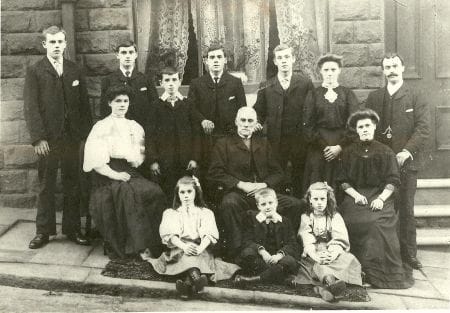
In the above pix, Patrick, the paterfamilias, sits in the middle. He was born in 1850 during the Famine in Coulimore, County Mayo, emigrating at some point to coal country, Wombwell, Yorkshire. He married Susannah Cox of Derbshire, who died giving birth to their 12th child. What English genius thought they could stop the Irish from reproducing by starving them?
Patrick Joseph, my grandfather, born in 1886, stands behind Patrick’s right shoulder. He started working in the Barnsley Seam coalmines when he was ten. Later, he spent a few years in the Australian coal fields around, Cessnock, New South Wales, which I understand is now a fancy wine area.
Returning to England during War I, in 1919, he'd land with father Patrick (died 1931) and a number of siblings in Chicago. For years, he worked in the Clearing Yard for the Belt Railway, the largest switching railway in the US. Belt is listed as employer on my dad's 1928 birth certificate.
Belt operated entirely in the Clearing Yard. They took apart the trains coming in, reassembled them, and sent them out again. My grandfather was a “knocker.” He made sure all the cars were securely connected and the doors closed before the trains left the yard.
He had six children with Mary Dayton of La Crosse, Wisconsin, the fourth was my father, James. Patrick died in 1945 at 55 from the bad lungs he developed as a kid working in the coalmines. That's when dad dropped out of high school to support his family, eventually working as a machine operator for over three decades in a factory just north of the Clearing Yard and having six kids with Mary Dwyer of Engelwood, Chicago. (Thanks to first niece Lauren for much of above.)
History is not deterministic, it’s contingent. What if Patrick had stayed in Oz? Here’s an American tune from one of his grandsons, only possible because Patrick came to Chicago.
A few months a go, Trippi set up a video call for me to get a campaign job. When it ended, I thought, “Damn, I haven’t had a call like that for decades.” It made me think how much people associate me with campaigns, despite my campaign heyday being between 1980 and 1992. No doubt during that time, I was a campaigning SOB. I did two presidential primary campaigns, one general, four state senate (three in Illinois, one in California), two Congressional races, and a mayor and city council race. That’s almost a dozen campaigns, not counting that a presidential primary runs are comprised of dozens of elections.
In the thirty four years since ‘92, I’ve only been involved in six campaigns, three very short Congressional races, another presidential primary run, and then three presidential elections on the African continent, two in Nigeria, one in Tanzania.
Ok, the only thing this all definitively says is your friend and humble narrator is old, frankly, older than you ever really want to be. Nonetheless in my campaign heyday, I was in the trenches of all these campaigns. I know the campaign process from top to bottom and won the majority of them. I didn’t get out because I wasn’t good at it. It was the 1980s, the campaign process was changing all for the worse.
In 1985, I spent the year in the office of the President of the Illinois State Senate Phil Rock, watching what had been the New Deal Democratic party fall apart. The putrid order from the rot wafted across everything. The old party organization was being replaced, just as Obama arrived, with money, polls, and television, a process of never ending degeneration.
The last campaign I ran was a 1990 Congressional primary in San Diego. Byron Georgiou, who at 28 had been Jerry Brown’s Legal Affairs Secretary in I guess what was Jerry’s second term, so many hard to keep track. But Byron ran against Jim Bates, a then five or six term incumbent Democrat. Bates had just been censored by the full House for sexually harassing his staff. No one got censored by the House, especially for sexually harassing their staff.
Two years before, the first campaigning I had done upon moving to California was helping the San Diego Rainbow Coalition elect their 44th CD delegate slate. Rainbow it certainly was – Asian and Pacific Islanders, African Americans, Mexicans, and even a couple Whites. They came within couple points of winning the whole thing. This got the Congressman's, Jim Bates, attention. Actually, adding this to the list you get an even dozen campaigns.
Byron was the only Democrat in San Diego willing to take on Bates. I was the only Democrat ready and willing to run the campaign. That’s right ladies, your friend and humble narrator ran the first Me Too campaign.
Byron, not I, decided to hire Tony Podesta to do the TV. Now some of you Clinton-ites and Obama-ites might recognize the name or at least that of Tony’s brother John. Tony was originally from Chicago, moved to DC, became a lobbyist and made millions upon millions. An especially lucrative career when your brother’s Chief of Staff to the President, one among a number of Executive Branch positions John held over sixteen years. In 2017, along with Trump partner Paul Manafort, Tony would infamously go down in a Russian money scandal.
Stepping back a few months, in the fall of 1989, what in hindsight appeared the first stirrings of Maga, Congress was going to vote themselves a big fat pay raise. They strong opposition organized through the Talk Radio Shows and publicly backed down. But then, this is where it get’s good, after saying the pay raise was dead, right before they adjourned, the members stuck it into a bill passed in the dead of night. When discovered a lot of people were very pissed-off.
For San Diego’s 44th Congressional District voters, the pay raise was half their annual incomes. Me, I thought, here’s an issue. But, Tony Podesta continually argued against using it. I couldn’t figure it out. We didn’t use it.
No one turned out to vote, 15% if I remember right. Bates had represented the district one way or other for 15 years. He had personally done enough for people to carry the race. With greater turnout in November, Bates lost the general in an overwhelmingly Democratic district. This campaign really made me want to get out, especially when DC women’s group like NARAL endorsed Bates. “He’s good on our issue.” I guess they weren’t woke enough yet.
I did one last campaign in 1992. My second presidential race, an alert to you, my fellow Americans, that the American political system was in serious trouble. This warning came from someone twelve years entrenched in the processes of campaigns and government. They were getting ever more corrupt, even more dysfunctional. If you, my fellow Americans, didn’t do something about it, it was only going to get worse, time has shown much worse.
The 1992 campaign was where I first met Pat Caddell, who had been talking to Jerry Brown. In 1987, the same year I moved to the Golden State, Pat left DC, closed down his polling firm, and headed west. We had dinner at a 24 hour diner in Santa Monica at 26th and Santa Monica Blvd. For two hours, we were in complete and violent agreement on the corruption and growing dysfunction of American politics, though Pat made me realize I was far underestimating the problems in DC. We both saw the desperate need for reforming this republic.
One issue we both heartily agreed could very effectively illustrate the problems was the pay raise. A couple weeks later we were talking, Pat said, “Make sure someone gets a copy of the pay raise agreement.”
I was like, “What pay raise agreement?”
“The one they signed and read into the Congressional Record.”
I was, “Come on, no way.”
Then in the exasperated bordering on the furiously angry tone he did so well, “Joe, just get someone to get it.”
Sure enough, right there in the Congressional Record was the agreement. It read the pay raise could not be used as a campaign issue. Any candidate who used it would not be supported by the parties or campaign committees. It was signed by then Chairmen of the parties, Ron Brown and Lee Atwater and whoever at that time represented the various Republican/Democratic Senate and House campaign committees. Here in black and white was DC conspiring to obstruct the election's process, the only direct citizen accountability tool.
I found the agreement beyond obscene. My mind instantly went to Tony Podesta arguing against using the pay raise, finally the explanation. Here’s candidate Brown giving a great and still important Caddell speech, waving the agreement in front of the DNC assembled in Los Angeles. DNC Chair Ron Brown, who I knew well from 1980 Kennedy campaign, sitting directly to his right. If nothing else, that campaign had a couple great moments of political theater.
Anyway, after ‘92, I got out, though my fellow Americans, I tried on several occasions to initiate some sort of reform effort, instead it all just got much, much worse. When the Clintons got to DC, the money spouts were open wide and full, everything was for sale – Oh Bubba!
Over the last fifteen years, I removed myself enough that no one sends me any campaign political news, for that I am grateful. There are a few exceptions, one is Byron, another is Ames, who enjoys sending things that will provoke me.
Yesterday, Ames sent me this New York Magazine piece on the Maine Senate race. I’m not going to go into detail, but it’s a fine report on how, to all our detriment, federal races are now controlled by a handful of DC numbnuts, using boatloads of corporate money. At this point, the whole thing is so putrid even a reporter from New York Magazine can be overwhelmed by the smell.
As I stated in the beginning, the worst part of this tale is over the last year, I’ve attempted to get some campaign work, not for any political reasons, but your friend and humble narrator needs some money and the campaign industry, of which he has no little experience, has billions and billions of dollars.
Another person I got back in touch with was Cara Brown, who’s been in Maine a long time. I’ve known Cara since 1992, she was first off that campaign. She was smarter than me. I had come to realize the only chance I had doing a campaign was getting on with an outsider. I got in touch with Cara, who I last saw at Caddell’s funeral, about Platner. She replied she wasn’t a Graham supporter as she “can't stomach the lying.” Beautiful. However, she did like Jackson and if he won the governor primary, she’d get me in touch with some of his people. Instead, Platner fell and Jackson became the Senate nominee. I emailed her writing Jackson “will have problems if he listens to the DC knuckleheads.” That is the whole NY Magazine piece.
I didn’t hear from Cara for a month, not so unusual in these matters. Then she sent me what she had received, basically a brushoff email. The delay had been caused, as the NY Mag piece reports, with the DC numbnuts securing control of the campaign.
In 2020 against Collins, these same people spent $60 million dollars getting only 350,000 votes and losing. As the article states, they left $14 million on the table because in sparsely populated Maine, they couldn’t find more commission paying TV or Net advertising to spend on. There is definitely some sort of debauched talent to all that.
What’s best about the NY Mag piece is it shows how little politics has to do with the whole campaign process. The people at the top of DC campaigning aren’t political. It’s simply a corporate exercise in marketing and advertising funded by those seeking to make money in return and there’s no more profitable investment than corrupted DC, just ask Donald Trump.
So I'll say once again, the US is in desperate need of political reform and that goes hand in hand with corporate reform. For this to happen requires a mass movement that restructures democracy in America. Campaigns should be limited to a month in length. What needs to be built in entirety are new political structures where American can come together to educate, learn, discuss, and decide the issues that impact their lives, only then can elections mean anything.
So goes an American tune.