
Classical Clever - Odysseus

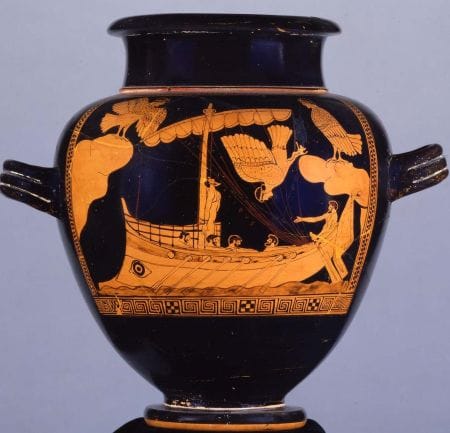
We are the Greeks. We are the Romans. We are the continuation of Western Civilization that began three thousand years ago. The Iliad and The Odyssey are a good, if somewhat random, marking of its start. Not totally surprising the contemporary West’s giant Hollywood entertainment machine released a massive reworking of The Odyssey. In story and devise, The Odyssey is great entertainment – action and adventure, plenty of sex, gods and monsters – in this sense it’s a perfect fit.
The Odyssey’s archetype characters are instantly recognizable to the contemporary reader, most especially the traits of the hero. Athena, his goddess patron, praises Odysseus, “To outwit you in all your tricks, a person or a god would need to be an expert at deceit. You clever rascal! So duplicitous, so talented at lying!”* Phew, you think she was speaking of America’s elite! Unlike our age, the Greeks didn’t consider being clever without fault. Odysseus’ cleverness was admired in relation to his life being determined by the gods. Never mind the Furies and Fates, if you had a god against you, especially if it's Zeus’ brother Poseidon and you have to cross the sea to get home, being clever is simple necessity. The same goes in matters of war where being clever means survival.
Endless fighting, killing, raping, sacking, pillaging, and enslaving were essential aspects of life and power in ancient Greece. After ten years of war, Odysseus’ first stop sailing from Troy is to overrun another town. He revels in telling the story, “I sacked the town and killed the men. We took their wives and shared their riches equally among us.” Today, Americans still confusedly revel in war, though far removed and largely ignoring war’s real death, brutality, and destruction.
Homer's Greeks had no bad conscience about war or its atrocities, which can be confusing for the contemporary reader. In classical times, war was bodies pressed together, swords, spears, and arrows, mano a mano, opposed to today’s distantly removed desk warriors, grotesquely represented by any random numbnut in the Oval Office unaccountably raining technological terror upon any people of their choice. Spilling endless seas of blood is not celebrated today, in fact rarely acknowledged, while the smallest drop of American blood spilled in its execution is considered failure.
Which gets to the biggest issue of difference between today and classical times, we are largely defined by technology. Science, the foundation of technology, knows nothing of Odysseus’ cleverness. Neither science or its technological offspring function by tricks, duplicity, or deceit. In fact, they are traits antithetical to both scientific thought and technological function. Interestingly, the Greeks gave us not only Odysseus, but laid the intellectual foundations for what two thousand years later became modern science and in last two centuries humanity's great industrial technological revolution.
In a 1958 talk, physicist (science) and first atomic bomb assembler (technology), J. Robert Oppenheimer, talked about the Greeks initiating scientific thinking. “The Greeks discovered something without which science would not be possible, this is the notion of rigor, the idea of proof, the idea of logical necessity, that one thing implies another. Without that of course, science is essentially impossible, because the trick of the sciences is to find out mistakes and unless there is a quasi-rigid structure of implication, if something turns out unexpected, you have no way of knowing where to look for the mistake, you have no way to correct yourself. The Greeks discovered this very early and codified it very early in their history.”
Nothing clever about this method, nothing clever about logical necessity. Athena’s appreciation of clever Odysseus has no place in science, where such thinking and actions would be considered mistakes at best, subterfuge at worse. In Oppenheimer’s words, “the trick of science” is to root out the clever with a process of unending correction. This is the only way science develops. In an era of technological warfare, clever leaves its adherents vulnerable, armed with a bunch of overpriced, not particularly useful weaponry.
Along with Hesiod, The Iliad and The Odyssey provided the foundational myths of Greek civilization. Most amusing, the gods best represented basic human character traits, though completely unbound and unimpeded. To gain a real appreciation of Greek culture, you need to turn to the philosophers who gave us science and the playwrights who gave us tragedy. Ironically, our contemporary world overwhelmed by scientific knowledge drowns in reactionary clever with zero appreciation for tragedy.
In regards to ancient tragedy, I read a real nice book on the Roman republic, The Storm Before the Storm, by Michael Duncan. It covers the era between the Gracchi and Sulla, the first fifty years of the republic’s last century. Most appreciated, he points to how historians over the centuries have criminally disregarded the Roman citizen-assembly in both its power and actions. But then across the centuries, most Roman history was written by elites for elites, both cared little for democracy, most entirely opposed any notion of it. One of the great exceptions was Machiavelli’s Discourses on Livy.
Reading Duncan's book brought back to mind how the republic flailed about in the last century trying to right a system that no longer worked and in the end couldn’t be righted. True government and political reform was never really considered, mostly just various attempts to reshape the edges. In the introduction, Duncan succinctly advocates why we today should more than ever care about Rome’s lessons,
"Further investigation into this period reveals an era full of historical echoes that will sound eerily familiar to the modern reader. The final victory over Carthage in the Punic Wars led to rising economic inequality, dislocation of traditional ways of life, increasing political polarization, the breakdown of unspoken rules of political conduct, the privatization of the military, rampant corruption, endemic social and ethnic prejudice, battles over access to citizenship and voting rights, ongoing military quagmires, the introduction of violence as a political tool, and a set of elites so obsessed with their own privileges that they refused to reform the system in time to save it."
The book focuses on a couple of things I’ve tried to convey over the years. Most importantly, the forces of the republican created empire imploded the republic. One great difference between then and now is the Romans eventually won all their “military quagmires,” not so these United States. Maybe we are offered opportunity the Romans didn't have?
Also, Duncan imparts the anti-republican economic changes created by the empire, most especially the destruction of the distributed small yeoman farm economy, replaced by vast centralized slave plantations. The majority of the politically enfranchised citizenry became economically disenfranchised. By the year 100 BC, wealth had become so concentrated a Tribune stood on the forum rostra speaking to the assembly exclaiming “not 2000 people own land in Italy.”
The book also did a good job showing the growing dysfunction of the republic's election system. Each election result became more contested, resulting in commission after commission, then, greater and greater violence. The book begins with the assassinations of the Gracchi brothers, the first time in centuries the republic saw domestic political squabbles settled with violence and ends with Sulla unprecedentedly marching Roman troops into the city. As Flowers conclusively argued in Roman Republics, Sulla was really the end of the republic, though its death throes continued another half-century.
The book made me look through notes I made on Ferrero’s unequaled, though unfortunately lost to history, Greatness and Decline of Rome. Ferrero’s most important insight advantage was he wrote with an almost century and half experience of modern republicanism. In an article he wrote in 1910 for The Atlantic, he states just that. “This is why a citizen of New York can more easily comprehend certain aspects of life in ancient Rome or Athens than a citizen of London or of Paris can, particularly as regards the rapid recurrence of elections which involve many interests.”
Most importantly, Ferrero understood the greatest difference between today and the classical was science and technology. He writes,
“The mercantile democracies of our own epoch depend, like all communities, upon sustained effort; but they depend upon an effort in which the struggle of man against nature exerts a more powerful leverage than the struggle of man against man. They depend, that is, upon industry: and the object of industry is to make the forces of nature subservient to human use. But in the effort which brought a mercantile democracy into being in ancient Italy, the struggle of man against man was far more powerful than the struggle of man against nature. In the face and in defiance of all tempting analogies there remains this great and essential difference between ancient and modern life.”
Couldn’t have put it better. Since the Greeks initiation of the methods of science, and most especially in the last two centuries of industrialism, the politics of technology have seemingly made nature not simply subservient, but in all sorts of artificial ways, nature is now continually and directly inserted into politics. The classical world was overwhelmingly, though not entirely, shaped through human interactions without technological mediation. Today, technology shapes all our relations and despite the unceasing cleverness continuously puked by our present Tech Lords, technology knows no clever.
The classical world offers unmatched insights on humanity and our relations to ourselves. Far too much has been forgotten or maybe even more disastrously cleverly and unhelpfully bent. Can you say Freud? Nonetheless, regarding our interactions and experiences with technology, the classical offers us little help. In the same 1958 talk Oppenheimer states,
“There's an enormous role played by tradition. The world we live in is a world where change is so great that tradition is emptied of much of its content. Emptied not because the tradition is not solid, but emptied because it has nothing in it to correspond to the questions, the problems, and the realities which erupt, partly because we know more, partly because we do more, partly because we act differently.”
No one better understood than Oppenheimer that clever offered no solutions to the gadget he helped create and war still so mistakenly revered. The Greeks and Romans are silent on the politics of technology. Their silence is nothing compared to our own. Most despairing, today, the clever reign unopposed. With all due respect to Athena, there's nothing to admire.
* From Emily Wilson’s translation.