
IEA World Energy Outlook

“We may remark at this point that modern physics is in some way extremely near to the doctrines of Heraclitus. If we replace the word `fire' by the word `energy' we can almost repeat his statements word for word from our modern point of view. Energy is in fact the substance from which all elementary particles, all atoms and therefore all things are made, and energy is that which moves. Energy is a substance, its total amount does not change, and the elementary particles can actually be made from this substance as is seen in many experiments on the creation of elementary particles. Energy can be changed into motion, into heat, into light and into tension. Energy may be called the fundamental cause for all change in the world.” ― Werner Heisenberg, Physics and Philosophy: The Revolution in Modern Science, 1958
In every way, energy is foundational to life. Start with the sun, the great fusion reactor in the sky, without which there’d be no life on planet earth. A half-million years ago, our ancestors learned to harness fire. It gave their bodies much greater access to all sorts of nutrients, allowing our brain to develop. Our brain sets us apart with an ability for abstract thought, information creation, and intricate communication. Only 2% of a person’s body mass, our brain uses 20% of its energy. It’s little wonder the human lust for energy is insatiable.
With industrialization, specifically the mass harnessing of fossil fuels, homo sapiens’ energy use transformed the planet’s landscape and its existing ecologies. The great deposits of coal, oil, and gas, all former life forms buried hundreds of million of years ago, offered a seemingly limitless supply of cheap and plentiful fuel. This cheap and plentiful supply shaped how we used the energy it generated. No energy practice was deemed wasteful or inefficient, in fact just the opposite, energy waste largely defined wealth. In the US, and no other people on the planet come close to per person energy use, many wasteful and inefficient energy practices came to be known as the American Dream.
Just as importantly, no accounting was ever taken of the social, environmental, or the military impact of American energy consumption. Such talk was ignored, deemed un-American. In the last several years, the next generation of compute technology marketed as AI calls for massive new energy demands. Physicist Angela Collier amusingly noted how so much Science Fiction, emphasis on the fiction, puts forth the idea of a linear growth in energy consumption as advancement. It is a lack of imagination our technologists have inherited, along with little or no ability to discriminate between fantasy and fact.
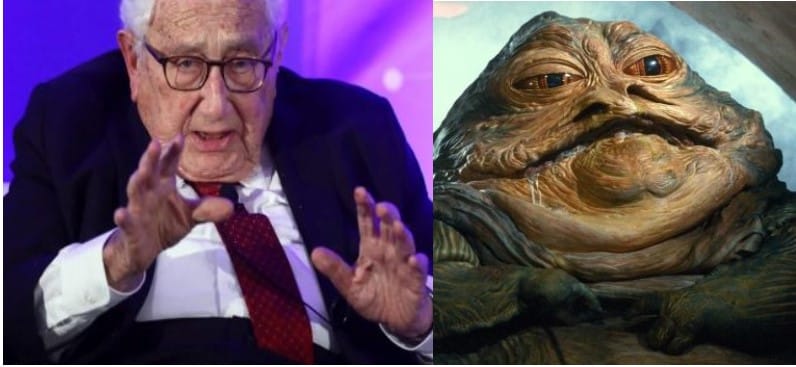
So, the International Energy Agency (IEA) came out with its new World Energy Outlook. In many ways, it’s pretty close to satire, but then it’s the IEA. Remember the IEA was founded by that great ghoul Henry Kissinger in response to the first global oil shock in 1973. Funny, the longer Henry lived the more he transformed into Jabba the Hutt.
Also remember for the first thirty years, IEA paid no attention to oil supplies and was anti-renewables. And efficiency, effici - what? You gotta ask what did IEA do?
The report starts, “Pressing threats and longer term hazards are elevating energy to a core issue of economic and national security.” As we all now know, energy was the core issue long before there was an economy or a nation state.
The report continues, “There is no single story line about the future of energy, which is why the World Energy Outlook presents multiple scenarios, none of which is a forecast.” Forty or so years ago, it might have come out of the energy times of the 70s actually, there were various intelligentsia types who pushed this idea of scenarios as essential for any smart corporatist. A couple of them were tied to Shell Oil. They talked about how Shell would move from being an oil company to an “energy” company. I guess with Shell now a global natural gas producer, one might say success.
Despite the IEA’s objections, scenarios are another way to say models and models are predictions. As physicist Niels Bohr said, “It is difficult to make predictions, especially about the future.” Over the last fifty years, there haven't been any models, aka scenarios, more consistently worthless than IEA’s. For example, just take their most recent years models, before this one, claiming, with little evidence, the decline of global fossil fuel use. Scenario emphasis is always the future, a future never arriving.
This is essential to understand in our wackadoo AI era, where our Tech-Lords claim with enough energy they can predict the future. Tech never had much use for scenarios, they just defined the future. However, it’s now clear, they took the old IEA approach to energy supply, it will just be there.
“Electricity is at the heart of modern economies and electricity demand grows much faster than overall energy use in all scenarios. It rises by around 40% to 2035 in both the CPS and the STEPS, and by more than 50% in the NZE Scenario.” “At the heart” is certainly an interesting metaphor. The only valuable scenario concerning our AI boys electricity lust is take the under.
IEA adds, “Traditional hazards affecting the security of oil and gas supply are now accompanied by vulnerabilities in other areas, most visibly in critical minerals supply chains.” Regarding traditional hazards of oil, put America’s blowing up the Middle East to secure remaining oil supplies top of the list. These “critical minerals,” they’re essential to both compute and electricity infrastructure. Not too mention and really whoever does, “Today, around 730 million people still live without electricity, and nearly 2 billion – one-quarter of the global population – rely on cooking methods that are detrimental to human health.”
Finally, the punchline, “Urgent energy security challenges are front and centre for today’s energy policy makers, requiring the same spirit and focus that governments showed when they created the IEA after the 1973 oil shock.” That’s just funny. The world’s in lot bigger energy fix now than in the 70s. Led by organizations like the IEA, we’ve wasted fifty years refusing to get any more energy intelligent.
Getting more intelligent doesn’t start with supply, it starts with what you do with energy. It’s exhilarating to think we can have infinite energy, a Disney cartoon like the sorcerers apprentice. Why not? After all, look at Einstein’s mass/energy equivalence – E = MC(2). Yet, what would you do with it? How much of the world would you destroy?
This all gets to the nut. If, and that’s an increasingly bigger if, this human race is going to continue into the future, looking back, a couple hundred years from now, industrialism is going to be considered an extremely primitive endeavor, most especially regarding both its resource and energy waste. Getting to that future point to look back requires us right now to rebuild from the ground up, using the knowledge and understanding we’ve acquired to build systems more efficient, elegant, and democratically collaborative. To not over value stuff but give a much greater value to energy, each other, and most especially this magical ability we have to collectively design our lives in ways we have yet to imagine.