
Politics Without Politicians

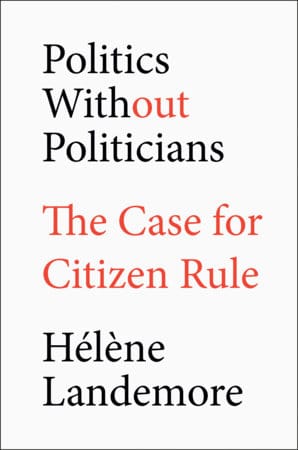
Over the last half-century, it’s become clear that not just the American system, but modern republicanism that spread across the globe from America’s founding is failing. A new book by Helene Landemore, Politics Without Politicians: The Case for Citizen Rule offers incredibly valuable thinking on how we might revive, reform, and evolve democracy for the 21st century.
Landemore begins, “The bad news: Electoral politics is beyond repair. The good news: Democracy isn’t. We can fix it.” She continues, “There’s a fundamental problem with the system itself. While electoral representation may have made sense two centuries ago, in a vastly different context and for very different populations, it’s no longer up to the task, especially in modern societies of educated citizens with access to information.”
Couldn’t have said it better myself and I’ve been saying something just like it longer than I care to think. However, the problem remains, most especially in the United States, while the vast majority now consider politics broken, the idea of necessary fundamental reform has yet to take hold. Landemore says of her students when confronted with the need for such change are at first “extremely deferential toward existing institutions.” This is not just an affliction of youth however, it’s far worse with age.
The systemic faults across our politics fail not just as process, but even more so as thinking. Serious thinking on the ever growing necessity of systemic change is ignored or waved off. Endlessly the system rinses and repeats established rubbish. “All that’s needed is electing new people,” an unending electoral charade where the newly elected failure, it is claimed, can just as soon be replaced. Never is it proposed the problems are systemic, that it matters not at all who sits in any given seat. The representative structure Landemore argues “most glaring point of failure lies in how we select our ruling class. The issue isn’t just governance—it’s electoral representation and the professional class of politicians it perpetuates” – Amen.
I’ll save myself going into the now tedious details of our present political dysfunction and simply list her subheads: “Money Corrupts, Power Corrupts, Lobbies, Incompetence, and Illusions of choice,” a very fine summing up. She goes into detail about the failures, starting with the view shared by Aristotle, Rousseau, and Montesquieu that electing magistrates was basically an oligarchic process. To think, not one of them ever experienced the American campaign system.
At the core of Politics Without Politicians is radical democratic reform. Today, democracy itself is not well understood. It’s useless to argue the present American system is democracy, thus our democratic experience is limited. In reforming this failing system Landemore writes, “My own vision (which is by no means the only possible one) centers on deliberative assemblies of citizens appointed through civic lotteries—large juries, if you will—and combines those with regular moments of mass voting on salient issues or issues put to a referendum by citizens’ initiatives, as well as other forms of local direct participatory mechanisms building on local practices and customs.”
Necessarily, all essential thinking about democracy begins with going back to the Greeks. Democracy ain’t a Greek word for nothing. After a fifteen-hundred year disappearance into private Byzantine libraries, the musty monastery cells of the Roman church, and Islamic thought, Europe's renaissance of Greek and republican Roman thought and history sprouted a fitful European neo-republicanism. Centuries later, with the Declaration and the founding of the United States modern republicanism was born. In opposition to the citizen assemblies of Greece and Rome, modern republicanism created electorally representative institutions.
In ancient Greece, elections were votes of citizen assemblies concerning issues, community processes, and fiscal matters, not personalities. Magistrates, government positions, were overwhelmingly filled annually by lot, randomly selected. All talk about equality in the last half-century pales in comparison to the established political reality Greek democracy required. “What was truly unique in Athens is the way that the poor and the rich were actual political equals. This was unheard of at the city-state level in the ancient world.” And it can be added, anywhere since.
Landemore looks to Pericles statement in his funeral oration that in Athens “a man may benefit his country whatever the obscurity of his condition.” In a system in which everyone sees himself as an author of the law, “respect for the authorities and for the law” ensures public order. This is an essential understanding of any democratic order, the ability for the citizenry to meet as equals to decide how the community will be shaped. Not just equality before the law, but equality making the law.
In addition to equality, Politics Without Politicians focuses on two other essential elements of any democratic system; accountability and the question of the specialization of knowledge or expertise. In regards to the first, many of America’s pantheon founders had a difficult time with any notion of democracy. In describing democratic elements of the system they created, they often referred to it as self-government. They agreed any notion of self-government came with the ability of holding all power accountable. In America today, power has no accountability, hence no self-government, no democracy.
Today, we are sold, literally, the idea accountability comes with the election process, however, at very least, when over 90% of incumbents are returned to office every election there is no accountability. Landemore points to the Athenian process of euthynai, where officials chosen annually by lot were afterwards subject to a very meticulous and public accounting of their actions and spending while in power.
Second is the question of expertise or specialization. There may be no greater difference between Ancient Greek society and today’s world than the growth of specialization. This tremendous increase in specialization is a result of the massive growth of scientific knowledge and the resulting exponential increase of both information and technology.
A century ago, Simone Weil, Landemore’s fellow École normale supérieure alum, wrote, “The whole of our civilization is founded on specialization, which implies the enslavement of those who execute to those who co-ordinate; and on such a basis one can only organize and perfect oppression, not lighten it.” Over the last century, specialization only grew ever more extreme, creating endless droves of experts completely entrapping the greater system.
In one of the most excellent parts of Politics Without Politicians, Landemore explores the question of how democracy deals with specialization, where experts are “on tap, not on top.” Beyond their narrow specialties, these priesthoods of experts are as ignorant of the rest of the world as the cashier at the 7-11. “Each of them is a layman outside his own narrow specialism,” noted Weil. In fact today, scientists and technologists even find it difficult to stay abreast of the newest knowledge of their own specialization.
Going again, and wisely, back to the Greeks, Landemore writes, “According to the historian Paulin Ismard, the only experts of any kind allowed to directly support the work of citizens as lawmakers were slaves. By turning to slaves rather than free men to occupy key positions in the technical administration of the city—such as archivists, accountants, and engineers—Athenians made sure that the inferior political and social status of their experts would prevent them from capturing power on the grounds of their superior technical knowledge.”
Again Weil writing of experts, “There is not a single disinterested judge amongst them, since each specialist, owing to the very fact that he is a specialist, is an interested party.” Experts create power hierarchies. They claim and provide data supporting ideas all such order they create is not simply best, but inevitable. They establish structural boundaries, crossing them requires fundamental reorganization.
Landemore, and I couldn’t agree more, recommends we look to the jury system. She proposes these citizen councils as add-ons to our present representative structures (I’ve previously advocated juries can provide much needed foundational restructuring). She puts forth several examples over the last decade where such lot-drawn councils/juries were successfully established in Iceland and France, surprising the professional political class with their nuanced and sometimes radical recommendations. However, as Hannah Arendt noted in On Revolution, like the spontaneous councils of the French Revolution and the soviets of the Russian, such participatory structures would be abandoned as soon as their participants lost real power to decide. Juries decide.
Landemore notes nothing has ever said democracy in America better than juries; “Alexis de Tocqueville—the nineteenth-century Norman aristocrat philosopher and author—teaches us in the first volume of his Democracy in America, possibly the best book ever written about both democracy and the United States. In rather lyrical pages, he singles out the jury, both civil and criminal, as a key political (and not just legal) institution of the young American nation. Indeed, as the epigraph above emphasizes, the jury is for Tocqueville ‘before everything a political institution’ and, specifically, a ‘mode of the sovereignty of the people’ alongside the laws that emanate from Congress." Juries are participatory decision making bodies.
Landemore provides valuable thinking about both juries and democratic selection by lot. She refers to these citizen councils and processes as minipublics. Toward the end of his life, one of history's great democrats, Thomas Jefferson, wrote the new United States needed to create “ward-republics.” Jefferson asserted, “The elementary republics of the wards, the county republics, the State republics, and the republic of the Union, would form a gradation of authorities, standing each on the basis of law, holding, every one, its delegated share of powers, and constituting truly a system of fundamental balances and checks for the government... Where every man is a sharer in the direction of his ward-republic, or of some of the higher ones, and feels that he is a participator in the government of affairs not merely at an election, one day in the year, but every day, he will let the heart be torn out of his body sooner than his power be wrested from him by a Caesar or a Bonaparte.”
Jefferson adds initiate these ward-republics “only for a single purpose; they will soon show for what others they are the best instruments.” Or as Landemore writes, “What we can learn, or relearn, from the Greeks is that political expertise is also acquired on the job. The less we give people an opportunity to participate, the less capable they are. The more we ask of them, the more they learn.”
When democracy fails, the solution is more democracy. For Americans, Politics Without Politicians is a reintroduction to democratic thinking, an indispensable beginning. The next step is to start talking with each other. From there a future can be designed not simply by the machinations of a few deviant, fantastical, narrow thinking technologists and a decrepitude of assorted unquenchable greedheads, but by us all.