The Persians

“My friends, whoever has experienced disaster understands that when a wave of trouble breaks over mortal men, they are inclined to be afraid of everything, and then, when good fortune blows their way once more, they start believing that this same good luck will keep on blowing them success forever. In my case, all things now look full of dread. My eyes can see the gods are enemies, and in my ears echoes a sound that brings no note of joy.” – Aeschylus, The Persians, 472 BC
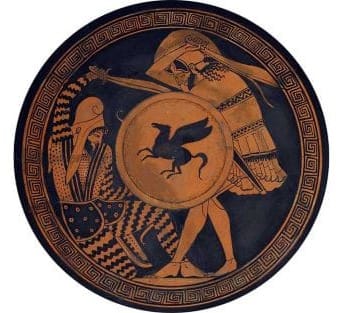
Two and half thousand years ago, Persia was the great empire. Athens and her Hellenes city-state allies were the far Persian periphery, in the process of inventing what would come to be called, maybe always ironically, Western Civilization.
The Persians tells of tiny democratic Athens' great victory at Salamis, stopping and putting to flight Xerxes the Great’s Persian forces. Aeschylus' tale is of the Persians' laments and despair resulting from imperial hubris, a condition knowing no timelines, no borderlines, no racial, no gender identities. Call it an unfortunate, unamenable human characteristic each age appears destined to learn anew.
In the first decade of the 20th century, the soon to end British empire discovered oil, black gold, Texas tea, along the eastern Persian Gulf. The Anglo-Persian Oil Company, today known as British Petroleum (BP), was formed. At the end of WWII, the American empire discovered Persia, understanding cheap and plentiful oil as a necessary component of America's brand of modernity.
From the get-go, imperial hubris defined America’s relationship to Iran. In 1953, after the new Iranian parliament and its Prime Minister nationalized the oil industry, America’s National Security Act of 1947 instituted imperial agency – the CIA, conducted a coup and restored the Shah to the Persian throne – a win-win situation.
After 25 years of extravagant and wasteful spending on "Made in America" military equipment – jets, helicopters, tanks, missiles, artillery, and guns – and at times brutal King of Kings' rule, the Pahlavi dynasty was thrown-off by the Iranian people. Students storming the American embassy held a group of American government hostages. For over a year, every evening, ABC's Ted Koppel assured an anxious nation it was America held hostage, an insult never since forgiven or forgotten in the secreted bowels of the US National Security State.
In losing Iran, the US was forced to scramble alliances around the Middle East. Israel and the Sauds became our new bestest allies and all that's come with that. Amusingly, the 1979 Iranian Revolution, like the fall of the Soviet Union, and maybe most recently the closing of the Strait of Hormuz, caught America's billion dollar intelligence agencies unaware.
What made all this especially poignant is America’s traditional oil supplies peaked in 1971, making the US more and more dependent on imported oil. In the last decade and a half, US reliance on oil imports temporarily lessened due to the truly incredible Shale Revolution, another immensely relevant story.
A couple months into the Hostage Crisis, then President and Democratic primaries candidate Jimmy Carter, also helped to the exit by the Iranian Revolution, announced in his State of the Union:
“Let our position be absolutely clear: An attempt by any outside force to gain control of the Persian Gulf region will be regarded as an assault on the vital interests of the United States of America, and such an assault will be repelled by any means necessary, including military force.”
Really, he should have said any outside or inside force, outside of the United States. Carter's efforts began by arming the mujaheddin in Afghanistan to stop the just launched Soviet march to the Persian Gulf. These efforts gave the United States Osama bin Laden. In the 45 years since, delusionally seeking control of the Persian Gulf, the United States spent trillions piling-up countless bodies. Cheap and plentiful oil from the Gulf is essential to the last half-century's corporate globalization project.
Finally, from the history doesn’t rhyme it repeats department, another lesson from the death throes of the Roman republic. In the 50s BC, what became known as the first triumvirate; Caesar, Pompey, and Crassus ruled. Crassus was one of the richest men in Rome, gaining his fortune via real estate, starting twenty years before as an astute and brutal scavenger feasting on Sulla’s proscriptions.
As Consul in 53 BC, Crassus took Syria for a glory seeking imperium. Without consent of the senate, he took on the Parthians, yes, you guessed it, that era's Persian imperial house. On the billiard flat Mesopotamian plains of southern Turkey, where today sits Harran, came the Battle of Carrhae. In wave after wave of Persian arrows, Crassus lost his life, his legions, and to the consternation of all Rome, the legions’ eagle standards.
Ever since, Carrhae's been considered the republic’s greatest military defeat. Though really, with obscene wealth concentration, vendetta as politics, and a corrupted and dysfunctional system leaving power totally unaccountable, it’d be hard to claim Rome a republic at that point.