WUSB Interview & Big Time Presidential Politics

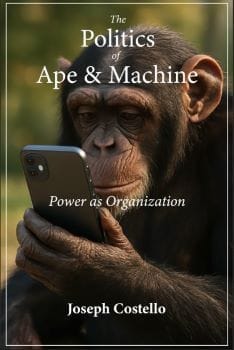
I did a great interview on The Politics of Ape and Machine with Ben Tallman at WUSB, the radio station for Stony Brook University out there on Long Island. Thanks Ben! He brought up Bernie Sanders at one point. Afterwards, I was thinking I should have told a good story about big-time American presidential politics and being slandered by a Bernie wielding Vermonter, hence my dislike of Bernie is not just political, though it is very much that, but also personal. In the interview we go into more detail about actual Barnie politics, most incredibly, how twelve years after the Dean effort, Sanders became the next popular and not very astute politician out of Vermont.
In 2003, after returning from 10 months in southern Africa, I started talking to Trippi about Howard Dean. I was so pissed about the whole Iraq criminality and occupation, I had to try do something. Dean was against, sort of, the war.
Trippi I knew a little. We had first briefly met in February 1980 in a hallway in the Ted Kennedy for President, Chicago HQ. Trippi just arrived from Iowa and was heading to the primary in Arizona. He was looking for people to leave the next day. I was greatly tempted, but decided against. Instead, I stayed on for the Illinois primary drubbing. Afterwards, I headed to Detroit and then Los Angeles, a month in each place. Unlike Illinois, we won both Michigan and California. Carter was an unpopular president, inflation will do that.
Twelve years later in the '92 Brown effort, I met Trippi a second time in a recording studio, early Friday morning a few days before the NY primary. We were cutting two ads. One was the candidate looking into the camera, vote for me. The second was Caddell's idea of sending a camera into Washington Square asking New York what they thought of the Clintons. "Lies," "Can't trust em," "Slippery and Slick," were the overwhelming replies.
Over last few weeks before New York, the Brown campaign had finally gained momentum, winning primaries in Colorado and then Connecticut. With an 800 number and talking to anyone who would talk to us media strategy, even with $100 contribution limits, we were raising money, even more in the last few weeks than the "we'll take anyone's money, of any amount, at anytime" Clintons. Simultaneously, as noted with our second ad (unfortunately didn't play, that's another story), the Clintons’ fundamental scumbag character had become an issue. We went into NY up seven points in the polls. Over the next two weeks, our campaign imploded. On election night, we ended up third in a two man race, which is an accomplishment in itself – big time presidential politics.
I left that campaign after the NY primary and didn’t walk into another campaign office for twelve years, when I went to Burlington, Vermont in June of 03. A month later, I moved to Burlington and Trippi put me right at the top of the campaign he had made a front-runner. The day I was hired, I sat with Trippi in his office. He listed five problems if not fixed would kill the campaign. We couldn’t fix them and they did.
I was made responsible for message, basically making all the campaign communication more disciplined, easier said than done. The major off-message offender was the candidate himself. The day I was hired, Trippi asked me to go out on the road with the candidate. No thanks, been there, done that. Instead, I went and sat in the middle of the internet crew. That was where the action was with this campaign and it was great. A good a campaign experience as I ever had. Unfortunately, it didn’t matter how good the net or the rest of the campaign was, if the candidate said whatever he wanted. With no message discipline, the writing was on the wall.
I walked into Trippi’s office one night and said, “Joe, I need to go out on the road with Howard.” I’ll always remember Trippi rolling his eyes and then sarcastically, and that’s about as sarcastic as you can get, responding, “Really?” A few days later I was out on the road with Howard.
I liked Howard personally, but his political acumen as former Mayor of Vermont leaved much to be desired. He wasn’t happy about me being there. He wished to continue saying whatever he wanted. He didn’t in anyway understand the process or the political times he was in. Howard’s message was just saying one way or another, "George Bush sucks," a crowd favorite. It should be noted twenty years later, the Dem message hasn’t changed, now it’s "Trump sucks."
It was now mid-November. I tried to explain to Howard the campaign hadn’t really started yet. If he didn’t expand his message and get disciplined about it, when the whip really came down, it would be all squarely on his back. His reply, if he got disciplined it wouldn’t be fun anymore. I couldn’t respond to that. The country had just brutally, illegally, and ignorantly occupied one of the biggest country’s in the Middle East. Holding the responsible people accountable for such idiocy wasn’t going to be fun, but it'd be immensely meaningful.
After ten fruitless days on the road, I’d give it one last shot. A big event, the Jefferson/Jackson Dinner, was coming at the end of the month. I wrote a speech about the decline of democracy in America, the increasing undemocratic concentration of wealth, and the growing leviathan corporate control of both the economy and politics. I put in a number of thoughts from Jefferson and Jackson backing up the main points. A good speech if I have to say so myself.
Surprisingly, I received push back inside the campaign. In my twelve years away from Democratic politics, the bourgeois cultural revolutionaries, who had been ascending to power in the 80s, were now ubiquitous. In their myopic view, Jefferson and Jackson were simply Indian-killing, slave-holding, white boys, or in other words, Americans. It was no longer acceptable for either the writer of the Declaration nor the great Tennessean opponent of concentrated money power to be recognized, much less turned to for any sort of political wisdom.
The afternoon before the dinner, I sat with Howard and his main Vermont political advisor Kate in a van in downtown Des Moines. I gave them the speech to read. Kate spoke first. “It sounds like Bernie Sanders.” Fuck, a knife in the belly. Now in 2003, most people didn’t know Bernie. He had long hid in the backwoods of Vermont and the backbenches of Congress, two places outside the halls of academia where anyone could claim in the first decade of the 21st century to be an American socialist. My fellow Americans, I knew Bernie and I was and am no Bernie Sanders.
Much more amusingly, the former governor said it sounded like Lyndon LaRouche. Again, unlike most of my fellow Americans, I knew who Lyndon LaRouche was. In fact, in 1986, a month after I had left my employment as political attache for the Illinois Senate President, three LaRouchies won the Democratic nominations for state-wide office. In the November general election, the Illinois Democrats had to run independents against their own primary winners. That’s what a mess the Democratic party was in one of the biggest states of the union in 1980s.
I went to the Jefferson/Jackson Dinner the next day. Not the Chair of the dinner, none other than Mrs. Bill herself, or any of the six or seven candidates, mentioned Jefferson or Jackson. The Iowa party would drop the two presidents from the name of the dinner a few years later. It’s now called the Liberty and Justice dinner. Howard gave his standard George Bush sucks rant. Howard was going to say what Howard wanted. The gathered Democrats ate it up, just as they do today's “Trump sucks.”
I went back to Vermont, spending the next few weeks trying to help counter the proliferating punches coming-in. None of them alone a knockout, but together they were doing damage and we had nowhere else to pivot. Winter in Vermont can be brutally cold and extremely dark.
Big-time American presidential politics, "Better than sex," said the Good Doctor Thompson.