
The Political Science of Energy & Information

"Humanity loves to ignore the questions of its origin and beginning: must one not be almost inhuman in order to follow the opposite course?"– F. Nietzsche, Human, All too Human
Introduction – Politics has proved somewhat impenetrable to being affected by science and its technological progeny. The easiest explanation is politics in the 21st century are broken, ironically enough, in no little part due to our inability to incorporate the knowledge gained by science. However, the prime reason might be Nietzsche’s above thought.
For centuries, science offered alternatives to once widely believed myths of our origin and the composition of life itself. We have been incapable of discarding many origin myths, they, not science remain embedded in much of our cultural thinking and many of our values. Even if they no longer prominently appear, they still influence.
Science offers few, if any, cultural or social commandments. Culture, society, and politics are not science. They are the greatest creations of Homo sapiens. Yet, when science and its technological progeny entirely reshape society, cultural and political values are instrumentally impacted by both, even if there's no real understanding of either.
Maybe modernity’s greatest fault was as science reshaped society, the political consequences were ignored, or worse, pseudo-science proliferated providing causes, excuses, and apologies for science’s and technology's impact on societal values. For over a century, secular priests espousing any manner of gibberish waved science texts above their heads invoking authority just as ancient prophets once waved stone tablets to claim legitimacy for any given political, cultural, or social value.
Science tells us how to do technology, it does not tell us what we should do with technology. What we do with technology is politics. Our societal ability to advantageously adopt technological change requires at least a rudimentary understanding of the science underneath it. This essay attempts to illustrate a few of the scientific concepts underneath the energy and information technologies presently roiling not just human life, but life on the planet for at least the last century.
The concepts are presented math lite, which is ok for at least grasping some of the ideas. Physicists, and physics is the science most responsible for the past century’s greatest technological changes, will endlessly tell you, the concepts can’t really be understood without the math. There is a certain exacting truth to that, however doing the math of quantum physics doesn’t really give you any sort of complete understanding to what’s going on, just an understanding, maybe, of how the math works.
The size of many of the numbers in quantum physics are beyond human comprehension. Not to mention, in key areas, the equations rely on irrational numbers, which as physicist Richard Feynman noted in a 1964 lecture at Cornell University, “Is a problem.” Nonetheless, the equations populated by these astronomical numbers work and working scientific equations give us the ability to devise technologies, like, bombs and shit.
However, it's important to point out in regards to the relationship between math and science, some math works completely without any sort of association to physical reality. Math can construct fantasies just as fantastical as the written word can, look at economics.
Physicists should be taken to task for not doing a better job conveying some of the underlying physical concepts math reveals, while just as importantly admitting that sometimes applying the math doesn’t really give you understanding of what’s physically going on.
Over many years, I’ve found originators of any given scientific theory offer some of the best explanations to their thoughts. If you want some understanding of relativity, some of the general concepts can be grasped without complete knowledge of the math. Einstein himself offered the best literal explanations. Regarding the math, start with E = MC2 and all that very simple equation implies.
This educational fault lies not just with physicists, all science education needs to be a lot better. As someone for decades who has read a lot of biology, I’ve thankfully found the writing has become a lot better in the last dozen years. Yet, one of biology’s most essential concepts in regards to origins, natural selection, was explained quite clearly by Darwin over a century and half ago.
The following essay is an attempt to vulgarly tie some fundamental physical concepts about energy and information to better consider the politics of the technology created. Against all hopes, it was written to spark some general political thinking, despite all politics being hopelessly brain dead. Specifically, it is a science polemic against the reckless rush instigated by a greedy and power lusting handful to rapidly adopt this latest generation of compute marketed as AI. These efforts should be opposed for no other reason than the massive increase in energy generation required, but also very much for the tyrannical order it will impose. There presently exist no politics to bring about any other result.
ENERGY
Energy is a funny thing. We know what it does – “work," and how it acts. But what exactly it is, well, that’s not really understood. In a 1964 lecture at Cornell, physicist Richard Feynman said this about energy:
"Physicists always like to feel so superior and smart and so on, that people would just like to get them once on something. So I’ll give you something to get them on. They should be utterly ashamed of themselves because they take the same thing, energy, and they measure it in a host of different ways, with different names.
"Absolutely absurd that energy can be measured in calories, in ergs, in electron volts, in BTUs, in horsepower hours, and kilowatt hours. All exactly the same thing.
"It’s like having money in dollars and in pounds and so on, but unlike the economic situation where the ratio can change, these dopey things are an absolutely guaranteed proportion. If anything could be analogous to it at all, the only hope would be to say that there are 20 shillings to a pound, with one complication. The physicist allows instead of saying he has 20 shillings to a pound, he says he has irrational ratios like 1.6183178 shillings to a pound.
"You'd think that the more modern high-class theoretical physicist would at least use a common unit, but you can find papers with degrees kelvin for measuring energy megacycles and inverse Fermis as a latest invention.
“We don't need any more inventions. We should all measure energy in exactly the same way. We should measure the energy in one unit and let it be done instead of having all these different names.
"Well the proof that physicists are human is the idiocy of all the different units which they use when they're measuring energy."
Understanding Feynman’s insight on the universality of energy is extremely helpful to looking at how humanity uses energy and more importantly, for what we use energy. At biology's most basic, when organisms ingest food, they convert energy from the sun. This energy powers all internal biological processes. Externally, with our body's muscles, heat, thought, and speech, though too often speech comes before thought, we individually and collectively project that converted sun energy back into and onto the greater world.
In the ten thousand years of the Agrarian Era, the age of farmers and pastoralists, using the energy of our bodies, domesticated animals, and rudimentary technologies, and maybe most importantly our ability to harness fire, humanity undertook a massive transformation of human culture and the planet’s established ecologies. In just the last last two centuries, with the industrial revolution, our species ability to harness even greater quantities of energy led to ever greater alterations of culture, the earth’s landscapes, ever greater portions of its seascapes, and the planet’s atmosphere. All changes we’ve yet to properly account. These industrial transformations of the last two-hundred years were accounted overwhelmingly with one single measure, their value in relation to industrial production and consumption. The single determining criteria of this value – MORE – the more production, the more consumption, the greater value.
Industrial energy was overwhelmingly generated by burning fossil fuels – coal, oil, and natural gas – ancient sunlight stored for hundreds of million years below the earth’s surface. Initially, industrial energy was generated by burning coal to create steam, then burning oil to power engines, and burning natural gas for light and heat. At the turn of the last century, all three began to be burned to generate electricity. A half-century later, the heat from fission reactors was added to the electrical generation supply. It's fuel, uranium, created before our solar system even existed.
Besides the physical transformation of the planet’s ecologies, this massive energy input transformed global economies, politics, and culture. The easiest example being at the founding of the United States, the dawn of the industrial age, 90% of Americans were farmers, today its less than 2%. At its simplest and most fundamental, all this change was an energy equation.
One of the great laws of physics is the First Law of Thermodynamics: energy is conserved, it can neither be created or destroyed. All energy transferred from one place, ends up somewhere else. Releasing upon the earth's surface the energy of all those fossil fuels subterraneanly stored for hundreds of millions years, according to the law of conservation, would radically transform the surface of the planet, indeed it did. The ever greater amounts of energy directly utilized for industrial production were crudely accounted, the tremendous waste, their rearrangement of society, and its impact on established ecologies, not well accounted or not at all.
An extensive First Law accounting requires calculating the redistribution of matter across the planet’s surface, along with the addition of gases to the planet’s atmosphere. The energy released felled trees, tilled land, crushed rocks, reforming them into concrete and asphalt arteries stretching across the planet and in other places piling them high into the sky. Measures in regards to social and cultural change taken not at all.
The most important energy accounting law is Newton’s Second Law: Force = Mass times Acceleration (F=MxA). A certain amount of energy (force) must be applied to move (accelerate) any given mass. The more mass, the more energy required to move it. Newton’s law is linear, everything goes in one direction, by knowing the equations numerical values, the outcome can be determined. This specific linear knowledge provided by Newton’s law encouraged the continuation of ancient, false notions of greater general determinism. A belief humanity was destined for some predetermined future. Newtonian determinism fit well, and no one argued the point more forcefully than Newton himself, with many of humanity’s previous origin myths. Past deterministic beliefs became literally incorporated into the idea of technological progress. Then myths of the past became assorted fantastical futures.
INFORMATION
(I use information and knowledge somewhat interchangeably. Information is a component of knowledge. Knowledge is organized information of greater value than simple raw data.)
Unlike energy, information can be both created and destroyed. Each step of technological “progress,” from our ancient ancestors’ stone tools and their harnessing of fire to modernity’s mass burning of fossil fuels required more information than previously existed. Agrarian society saw a massive increase of new information from hunter/gatherer society along with an accompanying loss of previous societal knowledge. Industrial society necessitated exponentially greater quantities of new information than agrarian society, again accompanied with a loss of previous knowledge.
While energy is the prime mover, knowledge is the prime designer. There is a not well understood relation, maybe correlation, between energy and information. The same math of the science of energy became foundational in the science of information. What precisely this might mean needs much greater investigation well beyond the scope of this piece.
Claude Shannon, one of the mid-20th century’s developers of information theory, which is foundational in the development of information technology, developed a math similar to entropy, the Second Law of Thermodynamics. In his introduction to Shannon’s A Mathematical Theory of Communication, mathematician Warren Weaver supplies a useful definition of entropy. Weaver writes,
“In the physical sciences, the entropy associated with a situation is a measure of the degree of randomness, or of "shuffledness" if you will, in the situation; and the tendency of physical systems to become less and less organized, to become more and more perfectly shuffled, is so basic that Eddington argues that it is primarily this tendency which gives time its arrow – which would reveal to us, for example, whether a movie of the physical world is being run forward or backward.”
Arthur Eddington is the Englishman who in 1919, using a solar eclipse, helping prove Einstein’s General Relativity. Eddington also first proposed stars were powered by fusion.
In his 1948 book Cybernetics, mathematician and engineer Norbert Wiener noted entropy’s fundamental role in communication theory,
“We have made of communication engineering design a statistical science, a branch of statistical mechanics. ...The notion of the amount of information attaches itself very naturally to a classical notion in statistical mechanics: that of entropy. Just as the amount of information in a system is a measure of its degree of organization, so the entropy of a system is a measure of its degree of disorganization; and the one is simply the negative of the other.”
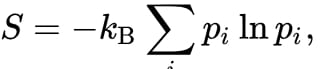
Stepping back three-quarters of a century from Shannon, James Clerk Maxwell of electromagnetism fame, appropriately enough given electricity's essential role with information technologies, and Ludwig Boltzmann developed statistical mechanics. Shannon's derived equation for information noise (disorder) was almost directly equivalent to Boltzmann’s equation for thermodynamic entropy.
Boltzmann’s equation for Thermodynamic Entropy,
Shannon’s equation for Information Noise
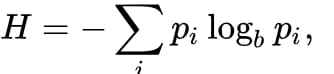
(A difference being the "k(B)," the Boltzman constant, a correlation between any given system’s distribution of gas particles and temperature, not necessary for discerning an information signal from noise).
Just as we know energy by what it does, not what it is, so Shannon wrote of information manipulation, “The semantic aspects of communication are irrelevant to the engineering aspects.'” For Shannon, information is simply defined as a pattern, a signal, propagated across a greater environment of noise or randomness. In Shannon’s communication theory, communicating information conveys no meaning, nonetheless, all communication between people conveys some sort of meaning.
Is this simply an equivalent math tool or does it suggest some sort of greater fundamental relationship between energy and information? Using the concept of entropy, Maxwell discovered a still underappreciated association between energy and information. In a thought experiment, he described a closed system with a degree of energy order moving to greater disorder, that is greater entropy. A “demon” placed atop the system and using information about the system could reverse the disorder, lessen the entropy. The Second Law says this is impossible.
For over a half-century, Maxwell’s idea flustered, until the remarkable physicist Leo Szilard disproved Maxwell’s notion. Szilard noted the demon would require a certain amount of additional energy to utilize the information, thus the system's over all entropy still increased. However, Maxwell’s demon pointed to the still greatly underappreciated idea of information’s ability to order energy.
Statistical mechanics introduced probability into the math of the physical sciences. Then, to Einstein’s eternal derision, quantum mechanics revealed probability not just a mathematical construct, but part of the workings of the universe itself. A couple decades later, quantum physics helped develop the first transistors leading to today's hundreds of billions of transistors on one compute chip. This facilitated the creation of ever vaster quantities of information.
Heisenberg’s quantum mechanics is also known as matrix mechanics. Matrices are simply tables, rows and columns of numbers (vectors), allowing the computation of ever greater numbers. Just as the math constructs of entropy became integral to Shannon’s communication theory, matrix math and probability are now integral to the software running across the latest generation of compute, a technology itself made possible by quantum mechanics. At this point, the astronomical amounts of data represented by these matrices can only be manipulated by ever expanding compute power. In the end, the so-called intelligence of these systems is entirely dependent on brute force compute. This brute force made possible only with ever greater amounts of energy.
What’s marketed as AI isn’t any sort of, excuse the pun, quantum leap. It has required over two centuries of thinking in math and science to get us here. Yet, we find ourselves with several immediate critical problems. The development of this technology proceeds as all technology has in the past with linear and deterministic thinking. Blame not only a physics still embedded with the myths of our ancient past, but also a society that so wants it to be.
Most alarmingly, when you hear the various fantasies of science limited and enchanted math technologists, understand beneath all their notions of progress remain very primitive deterministic beliefs. When you hear people talking about deterministic non-linearity or singularities, they’re entering fairy land, they might even show you the math.
FEEDBACK & HOMEOSTASIS
Norbert Wiener stated, “Information is information, not matter or energy.” With this understanding, he helped develop the concept of feedback in the mid-20th century. He credited Maxwell as feedback's originator. The concept and processes of feedback remain popularly unrecognized, though what science isn't? However, it has also not been well incorporated into much of our understanding of technological development, most especially and most ironically in regards to information technologies.
South African physicist George Ellis states, “It is the systematic use of meaningful information – e.g. that stored in DNA – that distinguishes biology from physics.” The processes of feedback are essential to biological information processing. Information adds what might can be perceived as a certain existential layer atop the laws of physics, a contingent, nondeterministic level. Feedback simply defined is the ability of any system to receive information back from an action taken and in turn alter the system’s next actions. Ellis states, “The point of a feedback control system is to make the initial state irrelevant as opposed to classic physics in which initial state determines outcome.”
Ok, this is an extremely radical idea. All physics, take for example F=MxA, the fundamental equation of industrialization, is based on understanding/controlling initial conditions. If you don’t have that, you can’t correctly determine the outcome of the action taken. Quantum physics tweaked this formula by adding how we measure a given action determines what we find.
The addition of information and the processes of biological feedback add complexity to the linear, vector determinism of physics with cyclical, open, contingent systems. A system that incorporates feedback is not a linear, one direction process, but changes as information is transmitted back and forth. This is not the reaction of Newton’s Third Law for every action there is an equal and opposite reaction, but something of greater complexity, something that in regards to living organisms defines organic, well, that and carbon.
Human technological development has overwhelmingly been a linear process. In regards to technological adoption, most feedback at the societal level has been muted or nonexistent. As an analog to Shannon’s definition of communication, technological development has no need of semantics, just signals picked out of noise following deterministic progress myths magnified by the new power structures it creates.
In cybernetic systems, whether organic or mechanical, robust feedback provides stability – homeostasis. This is most essential in regards to a system's’ utilization of energy. Thermodynamically, the human body uses almost innumerable parts working together at a relatively constant energy input to maintain a temperature of around 98 degrees Fahrenheit. This process of temperature stability is one of the body’s homeostatic systems.
Homeostasis is not achieved by forcing more energy into a system than necessary, in fact, just the opposite. Introducing surplus energy into a system in homeostasis forces it into disequilibrium, threatening not just the organism’s functioning, but its existence. There is an analogy with the history of human society and its systems providing at times political, cultural, and economic homeostasis. A linear expansion of energy creates disequilibrium, for example agrarian society systems and technologies overturning established hunter/gatherer societies. This new energy input eventually founded a new homeostasis, for example the harnessing of the Nile floods resulted in three-thousand year Dynastic Egypt.
Industrialization's two centuries exponential energy increase threw previous centuries and even millennia old established social systems, even older ecologies, and the planet’s atmosphere, into disequilibrium. The future might look back and say this era never reached a new equilibrium. Having still not properly accounted the energy loosed by industrialization, the idea of adding mass quantities more energy to power the latest generation of compute marketed as AI should be a red flag, even if it were technically possible and it isn’t.
In looking at the fanatic calls for compute’s energy needs, it is proposed in a relatively short time to drastically increase electricity generation through burning more fossil fuels, constructing numerous nuclear fission reactors, and promising still not capable fusion reactors. How such a massive increase of energy input would impact social homeostasis or those of surrounding ecologies, once again is not considered. The industrial value of more still the only measure. By rushing ahead to implement these information technologies along with their energy demands, we completely ignore the insight of Maxwell’s demon that information can organize energy. Instead we do just the opposite, using ever vaster quantities of energy to organize information.
For all its advances in power, compute has basically used the same architecture or system design from inception. This centralized architecture was and is taken advantage of by centralized corporations seeking to concentrate ever more power. The feedback process of all these centralized systems, as all in the past, are greatly restricted. They are deterministic. Societal power becomes concentrated, rigid, and less robust.
All technology inevitably becomes locked into certain architectures. The greater, more widespread a given technology’s adoption, the more difficult it is to change. Wider adoption always becomes most advantageous for a few, allowing the values of a small group of people and the values of the technology itself to be asserted over the greater society. Widely established technologies controlled by a handful of massive corporations can be as politically stifling, even more so, than any tyrant of the past.
Under present dominant societal values, the latest generation of compute will be mostly valued for its ability to automate. The process of automation, a process of control, are combined information and energy processes. All automation utilizes feedback but limited to lock in specific processes.
Just as importantly, in automating with compute the process isn't dealing directly with the actual physical world, but the world through a model, an approximation of reality. This does not in anyway suggest these models are not extremely powerful or useful, but it must be understood these models all contain elements of political power locking in specific ways of doing things. Once locked in, they become difficult to change.
Thus, it is critical before automating existing processes and institutions, comprehensive reassessments are undertaken of both. Considerations of whether they should even be automated gained not by know-how, but know-what. It is equally essential some form of human input is designed into and maintained in automated processes, each and every system. Automation is a process of repetition and control, not creativity.
The engineer's simplistic know-how valued exclusively by industrial more continues to overwhelmingly determine technological value. Wiener’s insistence on the need for know-what, a more complex political valuation provided in part through robust feedback remains largely nonexistent. Compute's most disturbed adherents proselytize ridiculous notions of creating some sort of super machine brain, a new, all knowing mechanical god bestowing benevolence upon us all. Ancient myths transformed into fantastical futures, a new era's determined progress.
In the Agrarian Era, the importance of information was recognized. The old centralized hierarchies of monarchs, emperors, and temples kept strict control of certain knowledge, for example keeping control of the calendar or money creation. In more recent times, tyrannical regimes sought control of books. With the birth of modern republicanism, its adherents realized the necessity of universal education and the free flow of information So, recognition of the importance of information for social organization is by no means new. To democratically do so in any way in the future requires political revitalization.
POLITICAL SCIENCE
Along with Wiener’s insight that information is neither energy or matter, we need to also understand information must manifest through either energy or matter to be utilized. Information technologies use both, yet these technologies have adopted the industrial undervaluing of energy. Massively undervalued by capital, the politics of energy were somewhat primitively understood or more accurately misunderstood by Marx. He badly misapplied energy’s value in the industrial equation by wrongly focusing on labor energy. Industrialism was made possible by one thing, the burning of fossil fuels. This global conflagration, not human labor, made industrial mass production possible. Focusing on human labor while ignoring the literal prime force missed the plot.
Marx’s focus on the machine and production led him to wrongly advocate the control of the means of production solved all problems. The wonderful 20th century political thinker Simone Weil took Marx to task for his production fetish, which he shared with his capitalist antagonists. Weil writes,
“The rise of big industry made of productive forces the divinity of a kind of religion whose influence Marx came under, despite himself, when formulating his conception of history. The term religion may seem surprising in connection with Marx; but to believe that our will coincides with a mysterious will which is at work in the universe and helps us to conquer is to think religiously, to believe in Providence. Besides, Marx’s vocabulary itself testifies to this since it contains quasi-mystical expressions such as ‘the historic mission of the proletariat’.”
A literal product of his times, most of Marx’s historical analysis was tripe, wrapped in Newtonian and even a mystic ancient determinism. It’s rather unsettling having to still comment on Marx a quarter of the way through the 21st century, but his latest bourgeois resurrection makes it unfortunately appropriate,... maybe? His contemporary rise represents nothing so much as a fatal atrophy of political thinking. It is a reaction to just as incredibly, two centuries later, the valuing of life by measures of production and consumption remain dominant and essential to today’s systems of entrenched power.
The influence of origin myths, whether two hundred or two thousand years old, help keep politics moribund. Most especially, the wrongly held belief in the wisdom of centralized control and its prayed for benevolence still dominates across society. Even the most modern republicanism never really turned from these ancient white sepulchers piled full of dead ideas and decrepit thoughts, with vital and alive science remaining politically inert. Two of the greatest scientific understandings of the last couple centuries, natural selection and quantum physics, essential to all origins, demonstrate how little or completely twisted their influence has been on political thinking.
Nothing better demonstrates the complete debasement of Darwin’s thought for political purpose than Social Darwinism, a deliberate misrepresentation of “survival of the fittest.” Instead of Darwin’s idea of fit, helpfully understood as a sort of evolving jigsaw puzzle, where many of the pieces and the puzzle itself continually change, fit, and refit together. Social Darwinism was devised to justify the greedy, grasping industrial powers of the day, a most detrimental propaganda still asserting itself largely unabated today. Ancient determinism once again reasserting itself as justification for centralized power in direct contradiction to Darwin’s distributed, dynamic, contingent view of life. Most distressing today, with the rapid expansion of biotech, the processes of natural selection remain as little regarded by the industry as they are across the rest of society.
Physicist and atomic bomb assembler J. Robert Oppenheimer once quipped as far as physics’ impact on culture, that what a century after Newton was defined as Newtonian would certainly never have been advocated by Newton himself. The more recent concepts of quantum physics have penetrated not at all or been bastardized to assert all sorts of fantastical notions.
There have been fitful attempts to bring science to politics. Certainly, in part, much of the environmental movement can be looked at as bringing science to politics, providing feedback to the great change industrialization wrought on established ecologies and species, including Homo sapiens. Environmentalism never became nearly influential enough, in most ways a curiosity as opposed to a real political force. It’s impotence demonstrated most vividly and recently in its full scale retreat in response to the latest reactionary push of industrial more.
One of the most sublime efforts to bring science thinking into politics was accomplished a century ago by Weil in her essay, The Illiad or the Poem of Force. She looks at the use of violence as an entirely apolitical action, a Newtonian force. She writes, “Force, in the hands of another, exercises over the soul the same tyranny that extreme hunger does; for it possesses, and in perpetuo, the power of life and death. Its rule, moreover, is as cold and hard as the rule of inert matter.”
She adds,
“Force is as pitiless to the man who possesses it, or thinks he does, as it is to its victims; the second it crushes, the first it intoxicates. The truth is, nobody really possesses it. The human race is not divided up, in the Iliad, into conquered persons, slaves, suppliants, on the one hand, and conquerors and chiefs on the other. In this poem there is not a single man who does not at one time or another have to bow his neck to force.”
Force in the Illiad is experienced universally, to borrow Shannon and his energy analogous communication theory, force is bereft of semantics, only the engineering matters.
The democratic thinker Hannah Arendt, who very much understood the concepts of quantum physics, that its resulting technology brought the forces of the universe, here she’s very much thinking nuclear weapons, into Homo sapiens previously earth bound reality. Any sort of understanding in this regard remains totally absent from politics. Today, across the planet, humanity works furiously to fission elements that existed in the universe before the sun and to bring the fusion processes of the sun onto the planet’s surface, in both instances remaining oblivious to First Law of Thermodynamics. Just as the earth's fossil fuels unleashed forces of disequilibrium across the planet's surface, the energy released from the universe will be conserved somewhere on this ever shrinking planet.
The real question, the radical political question for today is not how but what should be produced and consumed. This can only be answered by a vibrant, dynamic politics, a politics understanding its real purpose is creating, editing, and communicating information, using our bodily energy to come together to discuss and decide. A politics recognizing this as an existential, completely human, information layer. Such a politics can utilize compute and information technologies, but cannot be supplanted by them. If supplanted, as many advocates of this latest generation of compute promote, it will lead to a tech tyranny as incapable of change as its past forebears and even greater ecological destruction.
We need to bury our ancient origin myths, growing a much more organic understanding that the shaping and reshaping of life creates new realities to which our culture and politics evolve. There is no road to some already determined future, only a continuous, map-less journey. As that ancient and still relevant Greek Heraclitus put it, we never step into the same river twice.